
Leadership = High Agency
Based on Leadership in Practice Episode 278 taught by Charlie Kim & Meghan Messenger
There's a version of leadership that gets handed out like a prize. You hit a certain tenure, manage a few people, and suddenly you're a "leader." That model is dead.
In the world we're operating in now—AI eating junior roles, technical skills commoditizing overnight, organizations under constant pressure to move faster with less—leadership isn't a title. It's a survival skill. And it has a more precise name: High Agency.
If you don't have it, you're not just leaving performance on the table. You're at risk of becoming irrelevant.

What High Agency Actually Means
High Agency isn't confidence. It's not hustle culture. It's not a personality type.
It's a bone-deep conviction that reality is negotiable. That when things break—and they always break—your default response is "I will figure this out" rather than waiting for someone to hand you the answer.
Low Agency looks like this: executing tasks well, following the manual precisely, and calling that competence.
High Agency looks like this: seeing the gap between where things are and where they need to be, and building the bridge yourself.
The shift isn't cosmetic. It's a complete reorientation from "what am I supposed to do?" to "what does this situation need, and how do I drive it there?"
High Agency means you own the thesis. You own the outcome. And when things go sideways, you own that too.
The Performance Equation You're Probably Ignoring
Here's the framework that unlocks everything else:
Performance = Potential − Impediments
Most people spend their energy trying to maximize potential—skills, tools, strategies, tactics. That's the "offense." But they ignore the denominator. They leave the brakes fully engaged while flooring the gas, then wonder why they're burning out.
Potential is what you bring: your curiosity, your drive, your ability to visualize what's possible before you know exactly how to get there. It's the part that says "yes, and—"
Impediments are the brakes: ego protection, fear of looking wrong, micro-avoidances that pile up quietly until one day you realize your career has stalled and you can't pinpoint exactly when it happened.
The real unlock isn't working harder on potential. It's getting ruthlessly honest about what's braking you.
Micro-Avoidance: The Silent Career Killer
Nobody fails dramatically. Not usually.
What actually happens is slower and sneakier. It's the email you draft but don't send because you're not sure how it'll land. The hard conversation you schedule and then reschedule. The bold proposal you water down before it ever leaves your desk.
Each one of these feels like nothing. A minor course-correction. A sensible hedge.
But micro-avoidances compound. Six months of tiny retreats from discomfort adds up to a career that looks busy but isn't moving. A year of it and you've built a life optimized around ego protection instead of impact.
The question worth sitting with: what are you avoiding right now that your future self is going to pay for?
Visceral Drafting: How to Move Fast Without Moving Blind
The antidote to paralysis-by-analysis isn't recklessness. It's Visceral Drafting—the practice of rapidly forming a point of view before you act, even if that POV is incomplete.
Here's the core idea: you don't need the perfect answer. You need a directional answer, fast.
Research on high-stakes decision-making shows that even an eight-second window to draft your move before committing significantly improves outcomes. Not eight minutes. Not overnight. Eight seconds to get out of reactive mode and into strategic mode.
The metaphor that captures this best is the Tracer Bullet: instead of calculating the perfect trajectory before firing, you launch a round, watch where it lands, and adjust. Real-time feedback from the real arena beats theoretical calculation every time.
Approach | Energy State | Decision Speed | Execution Pattern |
Theoretical Planning | Bracing / Calculating | Stalled by perfectionism | Aim — Aim — Quit |
Visceral Drafting | Probing / Firing | Fast, iterative | Launch — Iterate — Win |
The leaders who consistently outperform aren't the ones with better information. They're the ones who get to a "good enough to act" decision faster, then course-correct in real time. Speed with iteration beats precision with paralysis every time.
Mission First: The Framework That Exposes Your Growth Edge
Most people, when they sit down to plan their day, default to what's comfortable. The emails that feel productive. The meetings that feel important. The tasks that feel manageable.
That's called "People First" or, more accurately, "Ego First." And it's where fear does most of its growing. Starts with how you feel, what you feel like doing…
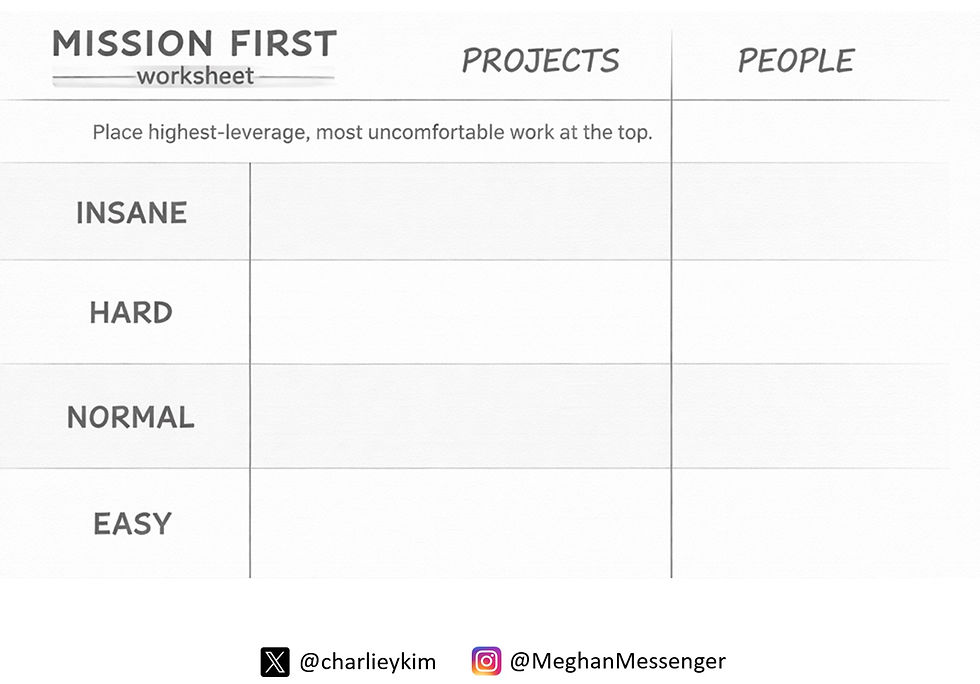
High Agency runs on Mission First. You start with the hardest thing on your list—not because you're a masochist, but because it's diagnostic. Hard missions reveal exactly where your current "standard edition" breaks down. They force you to develop instead of maintain.
Here's a simple way to think about your task landscape:
Level | What It Looks Like | The Goal |
Easy / Normal | Routine tasks, familiar territory | Build speed and boldness. Don't overthink. Train instinct. |
Hard | Complex projects, difficult people, high stakes | This is your actual development zone. Success here generates fuel. |
Insane | The stuff that causes shutdown or tunnel vision | Exposure work. Bring it into the light repeatedly until the fear shrinks. |
The "Insane" category is worth pausing on. We all have one. The mission, relationship, or initiative that causes a kind of mental shutdown—where suddenly everything feels urgent except that thing.
That's not a workload problem. That's a growth signal. The shutdown is telling you exactly where to invest.
Managing the Downside So You Can Dominate the Upside
Here's a counterintuitive truth about high-performance: the most important thing you can do for your upside strategy is stop trying to control the downside.
When your brain is busy predicting danger—running worst-case simulations, bracing for outcomes that haven't happened—it narrows. Literally. Peripheral vision shrinks. Creativity drops. The aperture closes.
High Agency leaders operate on a 5/95 split: 5% of mental energy on the downside, 95% on the upside.
That 5% isn't negligence—it's a clear-eyed assessment that you'll be okay no matter what happens. Not because you're naive, but because you've made a deliberate decision to "manage manageability" rather than manage every possible outcome.
When you genuinely believe you're going to be okay on the other side of the hard thing, something releases. You become fluid instead of tight. You can actually think. And from that state, your strategy gets dramatically better.
The leaders who seem fearless aren't the ones without fear. They're the ones who've found a way to make the downside feel survivable—so they can pour everything they have into the upside.
The AI Reality Check: Why High Agency Is Now Table Stakes
Let's talk about the world you're operating in.
AI models are exceptional at pattern recognition. Give them existing data, prior templates, established frameworks—they're faster and more precise than any human. That's not a threat if you understand what it means.
Where AI completely breaks down is in novel environments. In tests designed to measure "rule discovery"—the ability to figure out the underlying logic of a situation where no instructions exist—frontier AI models score below 1%. Humans? 100%.
Think about that for a second. In exactly the environments that define leadership—ambiguous, high-stakes, no manual—humans aren't just better than AI. They're operating in a different category entirely.
But here's the catch: that advantage only holds if you're actually using human judgment. If your value is following established patterns, you're on the wrong side of this shift. If your value is building theses from scratch, figuring out rules from first principles, and driving through uncertainty—you're indispensable.
High Agency isn't just a leadership philosophy right now. It's the specific human skill that AI cannot replicate. That makes it the highest-leverage thing you can develop.
The Training Partner You Actually Need
No one builds High Agency alone. But the support structure matters enormously.
What you need isn't a cheerleader. You don't need someone who validates your ideas and tells you you're on the right track. That feels good but it doesn't build anything.
You need a Training Partner—the gym-buddy equivalent of professional development.
Someone who:
Challenges your thinking instead of confirming it
Navigates conflict with you instead of avoiding it on your behalf
Creates a real arena where you can test authenticity, push your drafts, and get honest feedback
The Training Partner relationship is where you actually rep the skills. Hard conversations, iterative drafting, real-time feedback loops—none of that happens in isolation.
If you don't have one right now, that's worth taking seriously. The absence of challenge in your professional relationships might feel like stability. It's usually stagnation.
The Bottom Line
The world is no longer waiting for people who can execute instructions well. That gap is closing fast, and AI is closing it.
What remains irreplaceable is the human who can walk into uncertainty, build a thesis from scratch, own the outcome, and keep moving when the map runs out.
That's High Agency. And it's not a trait you either have or don't—it's a practice you either build or ignore.
Every morning you get to choose: fighter or victim, driver or passenger, agency or drift. The choice compounds faster than you think.
What's the hardest mission on your list right now? That's where you start.
Resources
Check out our free AiCoach trained to help identify your own automatics that trip you up.
Watch the full episode (with quick reference chapters) here.
Short Clips of Related Topics:
FAQ's
What if my organization is deeply Low Agency? Can one person actually change the culture?
More than you think, and it starts with a simple principle: you can only change what you own. You can't force High Agency into an organization by willing it. But high-agency individuals create a kind of gravity. They move faster, make better calls, take ownership visibly—and that creates contrast. Over time, the gap between how they operate and how Low Agency looks becomes impossible to ignore. Start with your own missions. The culture question becomes much less theoretical once you're operating differently.
The "Mission First" framework makes sense, but what if I genuinely can't identify what my hardest mission is?
That avoidance is the data. When you're having trouble naming the hardest thing, it's almost always because the hardest thing is something you've been very carefully not looking at. Try this: what's the task or conversation that creates the most subtle dread when you think about Monday morning? That's probably it. The obscuring is a feature of the pattern, not a coincidence.
You can also take advantage of our free AiCoach trained to help you identify mental patterns no longer serving you.
How do I practice Visceral Drafting without just making impulsive decisions?
The eight-second rule is the key here. You're not eliminating deliberation—you're front-loading it. Before you respond to the high-stakes email, the tense meeting moment, the ambiguous request: pause, draft your move internally, then act. You're training yourself to get to "good enough to launch" instead of "too uncertain to move." The iteration loop that follows is what catches the impulsive decisions before they become problems.
What's the difference between managing the downside and just being in denial?
Denial is pretending the downside doesn't exist. Managing the downside means acknowledging it clearly, making your peace with it, and then choosing not to give it 95% of your mental real estate. "If this goes wrong, I'll lose the client, and I'll survive that and rebuild" is not denial. It's a strategic decision about where to direct your cognitive energy. The distinction: denial collapses under pressure. Managed downside holds because you've already looked at it honestly.
I understand the theory, but how do I actually start building High Agency day-to-day?
Pick one thing from the "Hard" category on your mission list. Not the hardest thing in the world—just the one you've been actively avoiding. Set a fifteen-minute block this week to do nothing but sit with it: look at it, write down what specifically causes the shutdown, draft one small action. You're not solving it yet. You're doing exposure work—bringing it into the light so it loses its power to freeze you. That's the first rep. High Agency is built exactly like a physical muscle: one uncomfortable rep at a time.


